- Subject
- Nutrition
- Filed
- Source
- Edd Gent
- Loans
- 732
Plain-Language AI Protein Design Shows Promise, but Lab Testing Remains Essential
Pinal turns functional descriptions into protein designs, with early lab results ranging from one success in 29 candidates to five in 20.
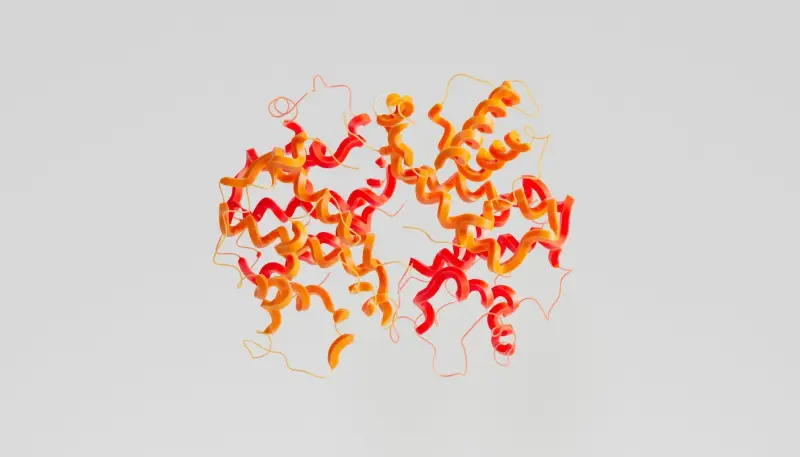
Protein-design software can now take a request written in everyday language and turn it into candidate amino-acid sequences. In early laboratory tests, the system Pinal produced proteins that performed several requested functions, but success rates varied sharply. The work suggests a new way to express design goals; it doesn’t remove the need for specialized experiments to find out whether a proposed protein works.
Designing proteins from scratch has typically required researchers to translate a desired job into technical instructions about molecular structure or sequence. Generative models have made it possible to propose proteins that aren’t found in nature, building on advances in predicting how amino-acid sequences fold. But using those models has still required expertise in specifying the constraints they should follow. Pinal, developed by researchers at Westlake University in China and described in Nature, is designed to let users begin with a description of a protein’s function.
From a written request to a sequence
Pinal has two modules. The first converts a natural-language prompt into a structural blueprint. The second uses that blueprint alongside the original prompt to generate an amino-acid sequence. Users don’t have to supply a target structure or specify which sequence positions to change.
The system also creates multiple possible designs rather than relying on one proposed structure. It builds sequences for the candidate blueprints, scores the resulting structure-and-sequence combinations, and selects a design. The researchers’ reasoning is that a protein’s ability to do a job may not be obvious from its shape alone, so evaluating several options can help identify candidates that a single design path might miss.
Training required a large collection of biological data. The team assembled about 135 million protein sequences, used language models to write descriptions of their functions, and produced roughly 1.7 billion sequence-and-text pairs. They then used AlphaFold to predict structures for the sequences. The two Pinal modules were trained separately: one learned to map text descriptions to structural blueprints, while the other learned to generate sequences using both the blueprint and the text prompt.
Four functions, uneven results
Researchers tested Pinal on four design tasks: creating a protein that glows green, an enzyme that breaks down PET plastic, an enzyme that processes alcohols, and a shuttle protein that moves chemicals between enzymes in a metabolic pathway. The system produced candidates for all four tasks, but the reported results show that generating a useful design can require substantial screening.
For the green fluorescent protein task, Pinal generated 50,000 sequences. The team narrowed these to 29 candidates for laboratory testing, and one fluoresced. That result shows the system could produce a working candidate, while also illustrating the gap between generating sequences and finding one that meets a functional goal.
The shuttle-protein task had a higher success rate: five of 20 tested candidates worked. The best candidate increased the output of a multi-enzyme carbon dioxide fixation pathway to 1.7 times the output achieved with the natural version. That finding is specific to the pathway tested; it doesn’t establish how Pinal would perform for other proteins or biological systems.
The reported tests offer early evidence that plain-language prompts can guide protein design through to laboratory evaluation. They don’t show that a prompt will reliably yield a working protein on the first attempt, or that the same approach will work equally well across different functions. The fluorescent-protein results, in particular, underline how many candidates may need to be generated and tested before one succeeds.
Another language model targets DNA
A separate project has applied related language-model ideas to DNA. Hugging Face and academic collaborators in China and Italy released Carbon-X, a 14-billion-parameter model based on Qwen3-14B. It was retrained on 300 billion tokens combining genomic sequences, biology text, and ordinary English. Carbon-X can answer questions about gene sequences, predict possible effects of mutations, and generate DNA sequences.
In five benchmark tests, Carbon-X outperformed Opus 5.5 and Gemini 4 Argon and scored less than one percent below GPT-6.1 Sol, according to the reported comparison. The model can also run on a MacBook, which could matter to researchers who want to analyze sensitive or unpublished sequences locally rather than share them with a commercial model provider. Benchmark scores measure performance on those tests; they don’t establish that generated DNA sequences will work in a lab.
Both systems have limits. Pinal’s developers say its screening methods may constrain the range of designs considered. Carbon-X has difficulty with long sequences and can produce inaccurate answers. For both protein and DNA design, experimental validation still depends on laboratory resources and scientific expertise.
The practical change is that researchers may be able to describe a biological function directly and use AI to generate candidates, without first translating every goal into detailed structural instructions. That could broaden who can explore protein-design questions, while leaving the central work of checking function to careful laboratory testing. The next meaningful evidence will come from further experiments showing how consistently these systems perform across a wider range of biological tasks.


